Knowing how to apply SUVAT equations in physics problems starts with understanding what each variable represents. The SUVAT equations are fundamental in AQA A Level Physics, used to describe the motion of objects under constant acceleration. Mastering these equations is essential for solving kinematics problems, particularly in mechanics.
Understanding the SUVAT Equations
The term SUVAT represents the five key variables involved in the equations of motion:
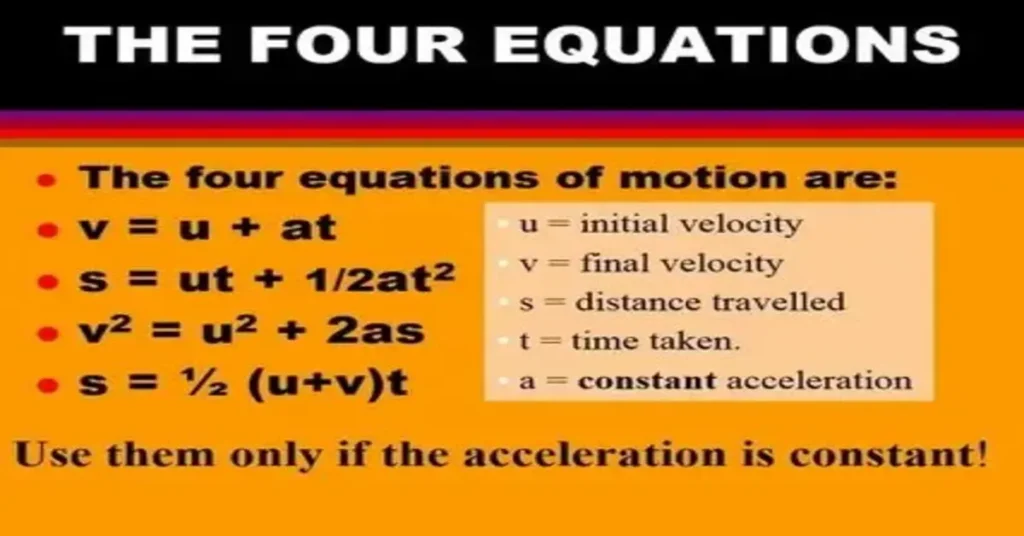
- s = Displacement (m) – the distance moved in a specific direction
- u = Initial velocity (m/s) – the starting speed of the object
- v = Final velocity (m/s) – the speed at the end of motion
- a = Acceleration (m/s²) – the rate of change of velocity
- t = Time (s) – the duration of motion
These equations only apply when acceleration is constant.
The Four SUVAT Equations
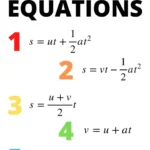
- v = u + at
This equation relates final velocity, initial velocity, acceleration, and time. - s = ut + ½at²
This equation helps determine displacement when time, initial velocity, and acceleration are known. - v² = u² + 2as
This equation is useful when time is unknown but displacement, initial velocity, and acceleration are given. - s = ((u + v)/2) × t
This equation is helpful when acceleration is not given, but the initial and final velocities are known.
These equations are provided in the AQA A Level Physics data sheet, meaning students don’t need to memorize them but must understand how to apply them correctly.
How to Apply SUVAT Equations in Physics Problems
- Identify the given variables: Carefully read the problem and list the known and unknown values.
- Choose the correct equation: Pick the equation that includes the known variables and the unknown you need to solve for.
- Use the correct signs: Since displacement, velocity, and acceleration are vector quantities, define a positive direction (e.g., upwards or right) and ensure consistency.
- Convert to SI units: Ensure all values are in standard units before calculations.
Special Cases to Consider
- Starting from rest: If the object starts from rest, then u = 0.
- Free fall: If an object is falling due to gravity, acceleration a = g = 9.81 m/s² (downwards).
- Braking or deceleration: If an object slows down, the acceleration is negative.
Worked Example
Question: A car accelerates uniformly from rest at 2 m/s² for 5 seconds. Calculate its final velocity and displacement.
Step 1: Identify given variables
- u = 0 (starting from rest)
- a = 2 m/s²
- t = 5 s
Step 2: Solve for final velocity
Using v = u + at:
v = 0 + (2 × 5) = 10 m/s
Step 3: Solve for displacement
Using s = ut + ½at²:
s = (0 × 5) + ½ (2 × 5²)
s = 0 + 25
s = 25 m
Final Answer: The car reaches a speed of 10 m/s and travels 25 meters.
Exam Tips for SUVAT Questions
- Always define a positive direction and be consistent.
- Check units before calculations to avoid errors.
- Use multiple equations if needed: Some problems require solving in steps.
- Practice past AQA exam questions to gain confidence and speed.
Conclusion
The SUVAT equations are essential tools in AQA A Level Physics for analyzing motion under constant acceleration. By understanding the principles behind these equations and practicing problem-solving techniques, students can improve their ability to tackle kinematics problems effectively.