If you’ve just calculated your DOTS score for the first time, the natural next question is simple: is this number good? There’s no single official cutoff for a “good” DOTS score, because the label depends on your experience level, your goals, and the pool of lifters you’re comparing yourself to. What DOTS gives you is a fair way to compare that number across different bodyweights and between men and women — something a raw total in pounds or kilograms can’t do on its own.
This guide walks through what a DOTS score actually represents, realistic score ranges by experience level, the factors that move your number, and how to calculate your own score in a couple of minutes.
What a DOTS Score Actually Measures
DOTS (Dynamic Objective Team Scoring) converts your competition total — the sum of your best squat, bench press, and deadlift — into a single number that accounts for your bodyweight. It was created by German powerlifter and statistician Tim Konertz in 2019 to fix a known weakness in the older Wilks formula, which tended to undervalue very heavy lifters and overvalue some lighter ones.
Because DOTS normalizes for bodyweight and sex, a 148-lb lifter and a 275-lb lifter can both post a DOTS score of, say, 380, and that score represents a comparable level of relative strength for each of them — even though their raw totals in pounds look completely different.
Is There a Universal “Good” DOTS Score?
Not really — and any calculator or article that gives you one hard number without context is oversimplifying. What counts as good depends heavily on training age, bodyweight, sex, and whether you’re comparing yourself to the general population or to competitive powerlifters. A DOTS score that would be exceptional for someone who has trained for eight months is unremarkable for a ten-year veteran of the sport.
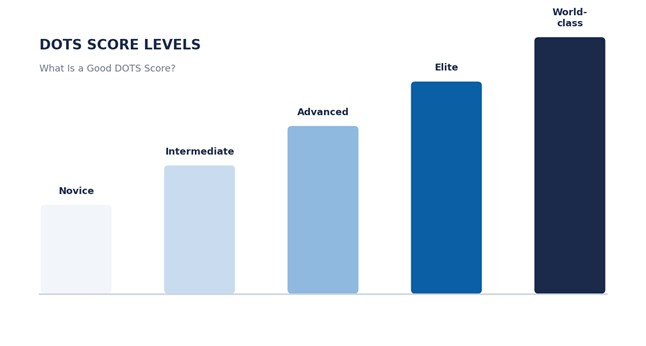
That said, most coaches and federations that publish reference tables (including USAPL- and USPA-affiliated meet directors) group DOTS scores into rough experience tiers. Treat the ranges below as general orientation, not a hard classification system — actual standards vary by federation, weight class, and sex.
Rough DOTS Score Levels by Experience
| Level | Typical DOTS Range | What It Usually Represents |
| Novice | Below 250 | First 6–12 months of structured training |
| Intermediate | 250–350 | 1–3 years of consistent, programmed training |
| Advanced | 350–450 | Multiple years of training with competition experience |
| Elite / National-level | 450–550+ | Long-term competitive lifters, often placing at regional or national meets |
| World-class | 550+ | Top competitors at international meets |
These bands overlap in practice, and outliers exist in both directions. A gifted novice with a background in another strength sport can post an “advanced” score in their first year, while a lifter recovering from injury might temporarily sit lower than their training history suggests. Use these ranges as a rough map, not a scoreboard.
Why Bodyweight and Total Both Matter
Your total (squat + bench press + deadlift) drives most of your score, but bodyweight determines how that total gets scaled. Because DOTS uses a curve fitted to real competition data rather than a straight-line ratio, it avoids the extremes some older formulas produced at the very light and very heavy ends of the bodyweight spectrum. In practice, that means gaining bodyweight without a proportional increase in total won’t automatically improve your score — and neither will cutting weight without maintaining strength.
How Sex Affects the Calculation
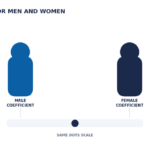
DOTS applies separate coefficients for men and women because average strength-to-bodyweight relationships differ by sex across the competitive population. This isn’t a value judgment on any individual lifter — it’s a statistical adjustment so that a male and female lifter with genuinely comparable relative performances land on similar DOTS scores. If you’re using a calculator, always select the correct sex category, since it changes which coefficient set applies to your total.
How to Calculate Your Own DOTS Score
You’ll need three numbers: your bodyweight, your sex category, and your total (best squat + best bench press + best deadlift, all from the same session or meet). Plug those into a free DOTS calculator and it will apply the correct bodyweight-based coefficient automatically — no manual polynomial math required. If you want to understand exactly what’s happening behind the scenes, our guide on how to calculate your DOTS score breaks the formula down step by step.
FAQ
What DOTS score is considered elite?
Roughly 450–550+ is typically considered advanced-to-elite territory, and scores above 550 usually belong to national- or world-class competitors. Exact cutoffs vary by federation and weight class, so treat this as a general guide rather than an official standard.
Is a DOTS score of 300 good?
For a lifter in their first couple of years of structured training, a DOTS score around 300 is a solid intermediate result. For a ten-year competitive veteran, it would be below their typical range. Context matters more than the raw number.
Does DOTS score differ for men and women?
The formula uses separate coefficients for men and women, but the resulting scores are designed to be comparable across sexes — a 400 DOTS for a woman represents a similar relative strength level as a 400 DOTS for a man.
Can I improve my DOTS score without gaining weight?
Yes. Since DOTS scales your total against your current bodyweight, any increase in your squat, bench press, or deadlift total at the same bodyweight raises your score.
How often should I recalculate my DOTS score?
Most lifters check it after every competition or significant PR test, since that’s when both bodyweight and total are captured accurately in the same session.
Is DOTS the same as Wilks?
No. DOTS was built specifically to correct accuracy issues Wilks had at the light and heavy ends of the bodyweight spectrum. See our comparison of DOTS, Wilks, and IPF Points for the full breakdown.