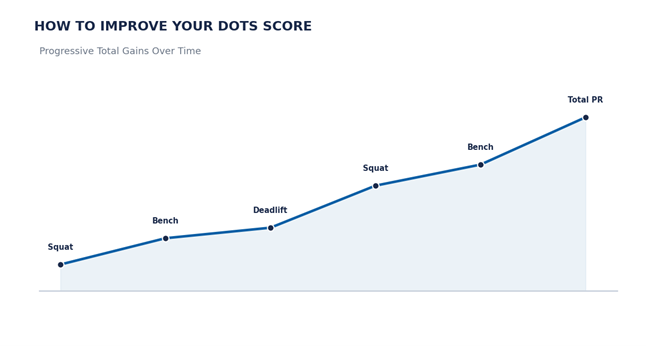
To improve your DOTS score, since it is calculated from your total and your bodyweight, there are really only two levers that move it: increase your total, or change your bodyweight in a way that improves your ratio. In practice, the most reliable path is almost always the first one — get stronger — with bodyweight management playing a secondary, situational role. This guide covers what actually influences your score and how to approach improving it without resorting to extreme or unsafe methods.
How to Improve Your DOTS Score: What Actually Moves It
Two variables feed directly into your score: your total (squat + bench + deadlift) and your bodyweight. Since the DOTS curve rewards total strength more than it penalizes moderate bodyweight increases, the highest-leverage way to improve your score for the vast majority of lifters is simply adding weight to the bar across your three lifts.
Increasing Your Total Strategically
- Prioritize your weakest lift — if your bench press lags well behind your squat and deadlift, focused bench work often yields the fastest total gains.
- Use a structured periodized program rather than random max-effort testing; progressive overload over months outperforms sporadic PR attempts.
- Track working weights and reps consistently so you can see genuine trends, not just day-to-day fluctuation.
- Peak intentionally before a meet or a planned max-out session — a well-executed taper can add meaningful pounds to your total on the day it counts.
Squat, Bench, and Deadlift: Lift-Specific Considerations
The squat and deadlift typically offer the largest total gains per pound of bodyweight added, since they involve more total muscle mass and a longer training history of proportional strength gains for most lifters. The bench press often responds well to targeted volume and technique work (bar path, arch, grip width) independent of bodyweight changes. A balanced approach that addresses your specific weak points — rather than only training your favorite lift — tends to produce the best total, and therefore the best DOTS score, over time.
Managing Bodyweight the Right Way
Because DOTS is a curve rather than a straight ratio, simply losing bodyweight is not automatically the best strategy — and can easily backfire if it costs you more total than the lighter bodyweight gains you back in coefficient. Bodyweight changes should generally follow your strength and performance goals, not the other way around:
- If you’re carrying bodyweight that isn’t contributing to your total, a slow, controlled cut (well ahead of any competition, not a rapid last-minute cut) may modestly help your score — but prioritize preserving strength throughout.
- If you’re chasing a higher total and have room in your current weight class, controlled bodyweight gain paired with progressive strength training is usually more effective than trying to “outscore” a bigger total through weight loss alone.
- Avoid rapid, extreme weight cuts purely to chase a DOTS number — they carry real health risks and often come at the cost of performance, which defeats the purpose.
Training Consistency, Technique, and Recovery
Long-term DOTS improvement is really long-term strength improvement, and that comes from the same fundamentals as any serious strength pursuit: consistent training over months and years, technical proficiency that lets you express your full strength safely, adequate recovery (sleep, nutrition, and fatigue management) between sessions, and a program structure that follows progressive overload without accumulating unnecessary injury risk.
Competition Preparation
If your goal is a DOTS PR at a specific meet, treat your final weeks as a distinct phase: taper training volume while maintaining intensity, dial in your opener/second/third attempt selection conservatively, and make your weigh-in weight a secondary consideration to hitting your best possible total on the platform.
Tracking Your DOTS Score Over Time
The most useful way to monitor progress is to recalculate your score every time you test a new total — after a meet, or after a structured max-effort testing session in the gym. Use our DOTS calculator to log your score in under a minute and compare it against previous testing sessions, so you can see whether your training is actually translating into relative strength gains, not just heavier lifts at a heavier bodyweight.
FAQ
Does losing weight always improve my DOTS score?
No. If you lose strength along with bodyweight, your score can actually go down. DOTS rewards total strength relative to bodyweight on a curve, not weight loss on its own.
What’s the fastest way to raise my DOTS score?
For most lifters, the fastest and most sustainable path is increasing your total through consistent, progressive training — particularly on whichever of the three lifts is currently your weakest.
How much can DOTS improve in a year?
This varies enormously by training age. Newer lifters can often see large jumps in their first one to two years, while experienced competitive lifters typically see smaller, more incremental gains.
Should I train specifically ‘for DOTS’?
Not really — training to maximize your actual total, with sensible bodyweight management, will improve your DOTS score as a natural byproduct. Chasing the number directly (for example, through extreme cutting) usually backfires.
Is it safe to cut weight before a meet to improve my score?
Extreme, rapid weight cuts carry real risks and can hurt your performance on the platform, which typically costs you more in total than you gain in coefficient. Any bodyweight change should be planned well in advance and prioritize maintaining strength.