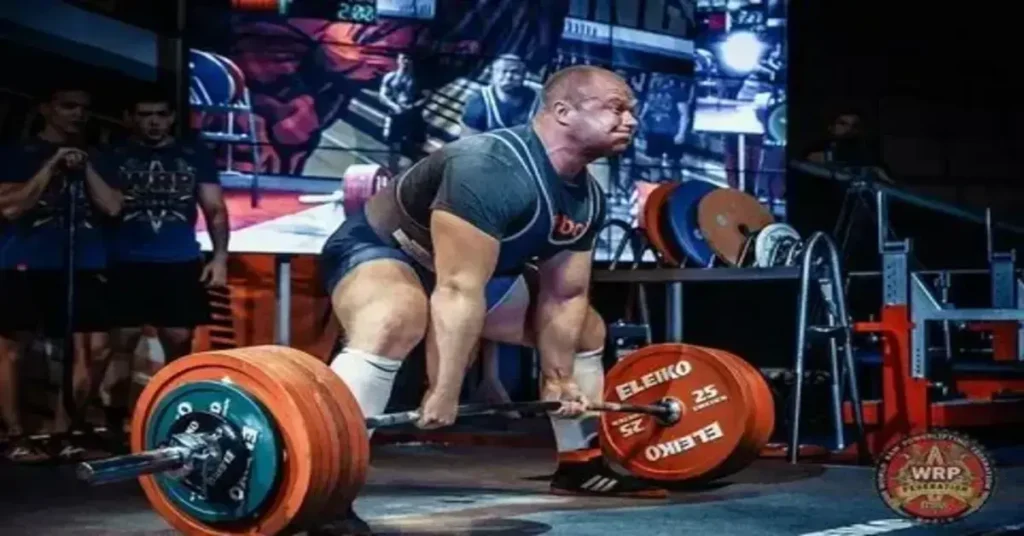
Powerlifting standards rank your one-rep max in the squat, bench press, and deadlift against your bodyweight, sorting lifters into five tiers — Beginner, Novice, Intermediate, Advanced, and Elite. Use the calculator below, or find your bracket in the tables further down.
Data last cross-checked: September 2026. Figures are interpolated from bodyweight-based strength benchmarks drawn from raw (unequipped) powerlifting competition results and widely-used strength-standard datasets. See Methodology below.
Try the Calculator
Enter your bodyweight, sex, and your best squat, bench, and deadlift to get your total and exact tier instantly, in kg or lb.
What Counts as a “Good” Powerlifting Total?
There's no single number — it depends entirely on your bodyweight and sex, because strength doesn't scale linearly with body size. A 480 lb total is elite for a 110 lb lifter and barely beginner for a 300 lb lifter. That's why standards are always read as bodyweight → total, not as a flat target.
- Beginner: achievable within the first few months of structured training.
- Novice: typical after a first 8–12 week program, roughly meet-ready.
- Intermediate: 1–2 years of consistent training; competitive at local/club meets.
- Advanced: regional/national-level competitor.
- Elite: top-percentile national/international performance.
Male Powerlifting Standards — Squat + Bench + Deadlift Total
In Pounds (lb)
| Bodyweight (lb) | Beginner | Novice | Intermediate | Advanced | Elite |
|---|---|---|---|---|---|
| 110 | 292 | 394 | 518 | 658 | 808 |
| 120 | 334 | 443 | 573 | 721 | 877 |
| 130 | 375 | 490 | 627 | 781 | 943 |
| 140 | 415 | 535 | 678 | 838 | 1006 |
| 150 | 454 | 580 | 728 | 894 | 1067 |
| 160 | 492 | 623 | 777 | 947 | 1125 |
| 170 | 530 | 665 | 823 | 999 | 1182 |
| 180 | 566 | 706 | 869 | 1049 | 1236 |
| 190 | 602 | 746 | 913 | 1097 | 1288 |
| 200 | 637 | 784 | 956 | 1144 | 1339 |
| 210 | 671 | 822 | 997 | 1189 | 1388 |
| 220 | 704 | 859 | 1038 | 1233 | 1436 |
| 230 | 737 | 895 | 1077 | 1276 | 1482 |
| 240 | 769 | 930 | 1116 | 1318 | 1527 |
| 250 | 800 | 964 | 1153 | 1359 | 1571 |
| 260 | 830 | 998 | 1190 | 1399 | 1614 |
| 270 | 860 | 1031 | 1226 | 1438 | 1655 |
| 280 | 890 | 1063 | 1261 | 1475 | 1696 |
| 290 | 918 | 1094 | 1295 | 1512 | 1736 |
| 300 | 947 | 1125 | 1328 | 1549 | 1775 |
| 310 | 974 | 1155 | 1361 | 1584 | 1812 |
In Kilograms (kg)
| Bodyweight (kg) | Beginner | Novice | Intermediate | Advanced | Elite |
|---|---|---|---|---|---|
| 50 | 132.5 | 180 | 235 | 300 | 367.5 |
| 55 | 155 | 202.5 | 262.5 | 330 | 402.5 |
| 60 | 175 | 227.5 | 290 | 360 | 435 |
| 65 | 195 | 250 | 315 | 387.5 | 465 |
| 70 | 212.5 | 272.5 | 340 | 415 | 495 |
| 75 | 232.5 | 292.5 | 362.5 | 442.5 | 525 |
| 80 | 250 | 312.5 | 387.5 | 467.5 | 552.5 |
| 85 | 270 | 332.5 | 410 | 492.5 | 577.5 |
| 90 | 287.5 | 352.5 | 430 | 515 | 602.5 |
| 100 | 320 | 390 | 472.5 | 560 | 652.5 |
| 110 | 352.5 | 425 | 510 | 602.5 | 697.5 |
| 120 | 382.5 | 460 | 547.5 | 642.5 | 740 |
| 140 | 440 | 522.5 | 615 | 717.5 | 820 |
Female Powerlifting Standards — Squat + Bench + Deadlift Total
In Pounds (lb)
| Bodyweight (lb) | Beginner | Novice | Intermediate | Advanced | Elite |
|---|---|---|---|---|---|
| 90 | 188 | 265 | 361 | 472 | 591 |
| 100 | 208 | 289 | 389 | 503 | 626 |
| 110 | 226 | 311 | 414 | 532 | 658 |
| 120 | 244 | 332 | 438 | 559 | 688 |
| 130 | 261 | 352 | 461 | 585 | 717 |
| 140 | 278 | 371 | 482 | 609 | 744 |
| 150 | 293 | 389 | 503 | 632 | 769 |
| 160 | 308 | 406 | 523 | 654 | 793 |
| 170 | 323 | 422 | 541 | 675 | 816 |
| 180 | 337 | 438 | 559 | 695 | 838 |
| 190 | 350 | 454 | 577 | 714 | 859 |
| 200 | 363 | 468 | 593 | 733 | 880 |
| 210 | 375 | 483 | 609 | 750 | 899 |
| 220 | 388 | 496 | 625 | 768 | 918 |
| 230 | 399 | 510 | 640 | 784 | 936 |
| 240 | 411 | 523 | 654 | 800 | 953 |
| 250 | 422 | 535 | 668 | 816 | 970 |
| 260 | 433 | 547 | 682 | 831 | 987 |
In Kilograms (kg)
| Bodyweight (kg) | Beginner | Novice | Intermediate | Advanced | Elite |
|---|---|---|---|---|---|
| 45 | 92.5 | 130 | 175 | 227.5 | 282.5 |
| 50 | 102.5 | 142.5 | 187.5 | 242.5 | 300 |
| 55 | 112.5 | 152.5 | 200 | 255 | 312.5 |
| 60 | 120 | 162.5 | 212.5 | 267.5 | 327.5 |
| 65 | 127.5 | 170 | 222.5 | 280 | 340 |
| 70 | 135 | 180 | 232.5 | 290 | 352.5 |
| 75 | 142.5 | 187.5 | 242.5 | 302.5 | 365 |
| 80 | 150 | 195 | 250 | 312.5 | 377.5 |
| 90 | 162.5 | 212.5 | 267.5 | 330 | 397.5 |
| 100 | 175 | 225 | 285 | 347.5 | 417.5 |
| 110 | 187.5 | 237.5 | 297.5 | 365 | 435 |
Powerlifting Standards vs. Competition (Wilks/DOTS) Scores
Bodyweight tables like these are the quickest way to check your level, but they don't account for weight-class competition or let you compare across bodyweights directly. For that, powerlifting uses normalized scoring:
- Wilks Score — the older, still widely-used formula for comparing totals across bodyweights.
- DOTS Score — the newer, IPF-preferred formula that corrects some of Wilks' bias at the extremes.
Use our DOTS Calculator to get your normalized score, our Wilks Calculator for the classic formula, or read Wilks vs DOTS vs IPF Points Explained for how the three systems differ.
Methodology & Data Sources
These standards are derived from bodyweight-indexed strength benchmark data spanning Beginner through Elite tiers, cross-referenced against raw (unequipped) competition results. Two important caveats, in the interest of transparency:
- Gym-reported vs. meet-verified data are not the same thing. Crowd-sourced strength calculators (self-reported lifts) tend to run higher than actual sanctioned-meet data, because of self-selection and inconsistent form standards. We treat these tables as general training benchmarks, not certified competition percentiles.
- Weight-class competition (IPF, USAPL, USPA) uses fixed weight-class brackets rather than continuous bodyweight — see our IPF GL Points Calculator for how weight-class-adjusted scoring differs from the tables above.
Reviewed by: Alex Johnson, Site Editor at Dots Calculator. Page updated September 16, 2026.
FAQs
What is a good powerlifting total for a beginner?
A beginner total is typically 2.5–3x bodyweight combined across squat, bench, and deadlift, achievable within the first few months of consistent, structured training.
Are powerlifting standards the same for men and women?
No. Standards are calculated separately by sex because of physiological differences in strength-to-bodyweight ratios, so the same total maps to different tiers for men and women.
What's the difference between powerlifting standards and Wilks/DOTS scores?
Bodyweight-based standards (like the tables above) sort you into a tier — Beginner to Elite — for your specific bodyweight. Wilks and DOTS are formulas that convert your total into a single normalized score, letting you compare lifters of different bodyweights directly, which is how most federations rank overall best-lifter awards.
Do these standards apply to equipped (suit/shirt) lifting?
No — these are raw (unequipped) standards. Equipped lifting produces meaningfully higher totals and isn't directly comparable.
How often should I re-test my powerlifting standards?
Every 8–12 weeks is typical — frequent enough to see real progress, infrequent enough to avoid missing gains from normal week-to-week fluctuation.