The DOTS score for men and women uses different coefficients, and understanding why matters if you want to compare results across sexes. One of the most useful features of the DOTS formula is that it lets you compare relative strength across sexes on a level playing field — but only if you understand how and why the calculation differs between men and women in the first place. This article explains how sex factors into the DOTS formula, why comparing raw totals between men and women doesn’t tell the full story, and how both male and female lifters can use their scores appropriately.
Check your own DOTS score. Enter your bodyweight and total and get DOTS, Wilks, Wilks2 and IPF GL in one click.
Open the DOTS calculator →Why the DOTS Score for Men and Women Differs
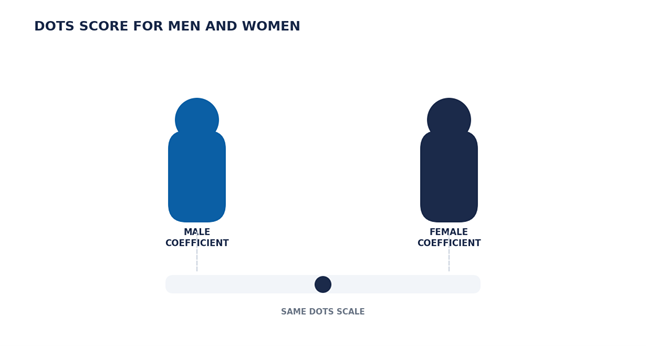
DOTS uses two separate sets of polynomial coefficients — one calibrated to male competition data, one to female competition data. This exists because, on average across large competitive samples, the relationship between bodyweight and total strength differs somewhat between male and female lifters. The coefficients aren’t a statement about any single individual; they’re a statistical adjustment so that the resulting scores represent comparable relative performance levels once applied.
Why Comparing Raw Totals Can Be Misleading
If you compare a 700-lb total from a 220-lb male lifter to a 500-lb total from a 145-lb female lifter using raw numbers alone, the comparison tells you almost nothing meaningful about relative strength — it’s comparing two different bodyweights and two different sex-based strength curves at once. Once both totals are converted to DOTS, however, you get two numbers built on the same underlying scale, making a genuine comparison possible.
How Bodyweight Affects Relative Performance for Both Sexes
For men and women alike, DOTS scores tend to compress somewhat differently across the bodyweight spectrum than a simple total-per-bodyweight ratio would suggest, because the formula is fitted to a curve rather than a straight line. This is part of why DOTS avoids inflating scores at the very lightest bodyweights or deflating scores at the very heaviest ones — the same design principle applies within both the male and female coefficient sets.
Using DOTS Appropriately by Sex
- Always select the correct sex category on your calculator — using the wrong coefficient set will produce an inaccurate score, not a slightly different one.
- Compare your own DOTS score over time as your primary progress metric; it removes bodyweight fluctuations from the picture.
- When comparing across sexes (for example, in a mixed “best lifter” award), DOTS is specifically designed to make that comparison fair — that’s its core purpose.
- Avoid drawing broad conclusions from a single comparison; individual variation is large, and DOTS reflects population-level statistical fitting, not a guarantee about any one lifter.
Competition Context
In meets where DOTS determines a combined “best lifter” award across both men’s and women’s divisions, this is exactly the scenario the formula was built for — ranking lifters of different sexes and bodyweights on one shared list. USAPL and USPA both use DOTS in this way for open-division best lifter awards, which is one reason the formula has grown in popularity since its introduction.
Calculating Your Score, Regardless of Sex
Whether you’re male or female, the calculation process is the same: enter your bodyweight, your sex category, and your total. Our use our DOTS calculator automatically applies the correct coefficient set once you select your category, so there’s no need to track down separate formulas or tables.
FAQ
Is DOTS fair to female lifters?
DOTS was specifically designed with separate, data-fitted coefficients for men and women so that scores represent comparable relative strength across both, which is generally viewed as more equitable than using a single unisex formula.
Can a woman have a higher DOTS score than a man?
Yes — DOTS scores individual performance relative to a sex- and bodyweight-based curve, so a woman with an exceptional relative total can absolutely outscore a man with a lower relative total.
Why do male and female DOTS calculators give different results for the same total?
Because the underlying polynomial coefficients differ by sex, reflecting differences in the average bodyweight-to-strength relationship across large competitive samples.
Does DOTS account for age as well as sex?
No — DOTS itself only adjusts for bodyweight and sex. Age-adjusted comparisons in powerlifting typically use a separate system, such as the McCulloch coefficients applied on top of the base score for masters divisions.
Should men and women use different DOTS calculators?
You don’t need separate calculators — one properly built DOTS calculator applies the correct coefficient set automatically once you select your sex category.
Check your own DOTS score. Enter your bodyweight and total and get DOTS, Wilks, Wilks2 and IPF GL in one click.
Open the DOTS calculator →