If you want to calculate your DOTS score by hand, the formula looks intimidating at first, but the concept behind it is straightforward: take your competition total, and scale it against a curve based on your bodyweight and sex. This guide explains what the formula is doing conceptually, walks through a full example calculation, and shows you the fastest way to get your number without doing the math by hand.
What You Need Before You Start
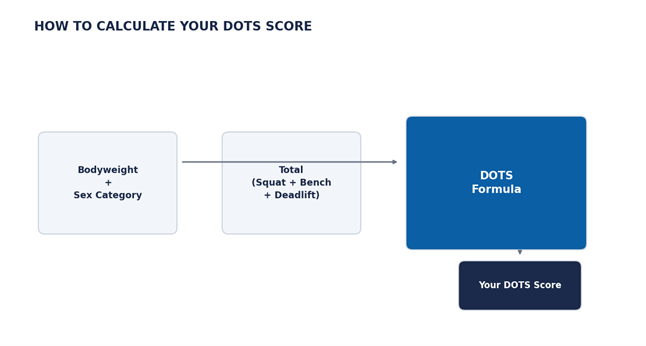
- Bodyweight — your weigh-in bodyweight in kilograms or pounds, taken the same day as your lifts.
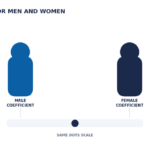
- Sex category — DOTS uses separate coefficients for men and women.
- Total — your best successful squat + best successful bench press + best successful deadlift, all from the same session or competition.
If any one of these three inputs is off — for example, using a bodyweight from a different day than your lifts — your resulting score won’t accurately reflect your performance.
Why the DOTS Formula Exists
Before DOTS, most federations used the Wilks formula (introduced in 1994) to compare lifters across bodyweights. Wilks worked reasonably well for lifters in the middle of the bodyweight range but became noticeably less accurate at the very light (under about 52 kg) and very heavy (over about 120 kg) ends. Tim Konertz built DOTS in 2019 using a 4th-degree polynomial fitted to modern competition data specifically to smooth out that inaccuracy across the full bodyweight spectrum.
The DOTS Formula, Conceptually
The structure of the formula is:
DOTS Score = Total × 500 ÷ (a·BW⁴ + b·BW³ + c·BW² + d·BW + e)
Here, BW is your bodyweight in kilograms, and a, b, c, d, and e are fixed coefficients — different sets for men and women — derived by statistically fitting the curve to a large sample of real competition results. The denominator (the polynomial) produces a bodyweight-specific scaling factor; dividing 500 by that factor gives you a coefficient, which is then multiplied by your total.
In plain terms: the formula figures out “how much total should someone at this exact bodyweight be expected to lift,” and scores you relative to that expectation.
Step-by-Step: How to Calculate Your DOTS Score
- Record your bodyweight in kilograms (convert from pounds if needed: kg = lbs ÷ 2.2046).
- Add up your best squat, bench press, and deadlift from the same session to get your total in kilograms.
- Select the correct sex-specific coefficient set (male or female).
- Plug your bodyweight into the 4th-degree polynomial denominator using those coefficients.
- Divide 500 by that denominator result to get your personal DOTS coefficient.
- Multiply your total by that coefficient to get your final DOTS score.
Example Calculation (Illustrative)
To make this concrete, here’s a simplified, clearly labeled hypothetical example — not an official reference table:
Imagine a lifter with a bodyweight of 83 kg and a competition total of 500 kg (squat + bench + deadlift combined). After applying the male coefficient set to that bodyweight, the polynomial denominator produces a scaling factor. Dividing 500 by that factor yields a coefficient — let’s call it roughly 1.2 for illustration — which is then multiplied by the 500 kg total. The resulting DOTS score in this hypothetical example lands in the mid-300s to low-400s range, depending on the exact coefficient values used.
The precise coefficient values are numerous, decimal-heavy, and easy to mistype by hand, which is exactly why almost every competitive lifter uses a calculator instead of computing the polynomial manually.
Why Using a Calculator Is Easier (and More Accurate)
The DOTS denominator is a 4th-degree polynomial — meaning your bodyweight gets raised to the 4th, 3rd, and 2nd powers, each multiplied by a coefficient carried out to several decimal places. Doing that by hand introduces easy rounding errors, and a small mistake at that stage can shift your final score by a meaningful margin. Our DOTS score calculator runs the exact formula instantly — just enter your bodyweight, sex, and total, and get your score with zero manual math.
FAQ
Do I need my total in kilograms or pounds?
The DOTS formula is built around kilograms, so if you compete or train in pounds, convert first (kg = lbs ÷ 2.2046). Most calculators, including ours, accept either unit and convert automatically.
Can I calculate DOTS from gym lifts, not just meet lifts?
Yes, though DOTS is most meaningful when the squat, bench, and deadlift come from the same session, ideally tested with proper form and full range of motion similar to competition standards.
Why does my DOTS score change if my bodyweight changes but my total doesn’t?
Because the formula scales your total against a bodyweight-based curve, any change in bodyweight shifts the denominator, which changes your coefficient — even if your total stays exactly the same.
Is the DOTS formula the same for raw and equipped lifters?
Yes. Unlike IPF GL Points, DOTS uses the same formula regardless of equipment category, which is one reason some federations prefer IPF GL specifically for equipped competition.
What’s the fastest way to get my DOTS score?
Use a dedicated DOTS score calculator — enter bodyweight, sex, and total, and the coefficient calculation happens instantly.