Beginners get confused because federations switched formulas at different times, calculators online often show outdated coefficients, and the names sound interchangeable even though the underlying math is not. A 100 kg lifter and a 60 kg lifter can put up wildly different totals and still be equally impressive — these formulas are how that gets measured.
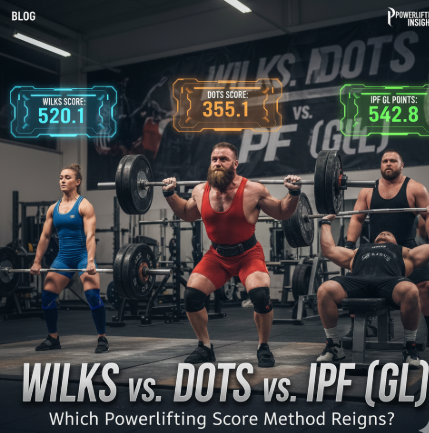
This guide breaks down how each formula works, why DOTS and IPF GL replaced Wilks, which one is the most statistically fair, and which one you should actually use depending on whether you’re a casual lifter, a USAPL competitor, or chasing IPF Goodlift standards.
Quick answer: Not sure which one applies to you? If you compete in the IPF, use IPF GL Points — it’s the only one your federation will score you on. If you compete anywhere else (USAPL, USPA, local meets) or just want a general-purpose score, use DOTS. Only use Wilks if you’re comparing to a pre-2020 result that was already recorded in Wilks.
How to Calculate Your Score in 3 Steps
You don’t need to do the math by hand. Every formula on this page needs the same three inputs:
- Bodyweight — your official weigh-in weight in kilograms (convert from pounds if needed).
- Total — your squat, bench press, and deadlift added together, in kilograms.
- Gender and, for IPF GL, equipment category — raw or equipped, since GL Points scores each differently.
Plug those three numbers into the DOTS Calculator, Wilks Calculator, or IPF GL Points Calculator and you’ll get your score instantly, with no manual polynomial math required.
What Are Powerlifting Points?
Powerlifting points (also called coefficients or scoring formulas) convert a raw total — squat plus bench press plus deadlift — into a bodyweight-adjusted number that can be compared across weight classes and genders.
Why bodyweight matters: strength doesn’t scale linearly with bodyweight. A 220 kg total from a 59 kg lifter represents a much higher level of relative strength than a 220 kg total from a 140 kg lifter, because heavier lifters carry more muscle mass and leverage advantages by default.
Why total alone isn’t enough: if competitions ranked lifters purely by kilograms lifted, every “best lifter” award would go to a super-heavyweight. Scoring formulas correct for this by fitting a mathematical curve to how strength typically scales with bodyweight, then using that curve to normalize every lifter’s total onto the same scale.
This is why formulas exist at all — not to replace the total, but to answer a different question: who performed best relative to their bodyweight?
What Is the Wilks Formula?
Short answer: Wilks is a bodyweight-adjusted scoring formula created by Robert Wilks in 1994. It was the standard powerlifting coefficient for roughly 25 years before being phased out in favor of newer formulas.
History and Creator
Wilks was developed by Australian powerlifter and administrator Robert Wilks and adopted by the IPF in the mid-1990s. For over two decades it was the default way to compare lifters of different bodyweights at both amateur and elite levels.
How It Works
The Wilks formula multiplies a lifter’s total by a coefficient derived from a 5th-degree polynomial based on bodyweight. Separate coefficient sets exist for men and women. The output — the Wilks score — is meant to represent relative strength on a single comparable scale, regardless of weight class.
Advantages
- Simple to calculate and widely recognized by older lifters and coaches
- Extensive historical competition data exists in Wilks format, useful for comparing performances across decades
- Still used informally on leaderboards and by lifters tracking long-term progress
Limitations
- The polynomial was fitted to competition data from the early 1990s, which is now statistically outdated
- It systematically favored certain bodyweight ranges, particularly rewarding lighter lifters more than the data justified as strength standards evolved
- It does not account for raw versus equipped lifting differently
- It has not been updated to reflect modern world-record trends
Why Federations Moved Away From It
As more competition data accumulated and statistical modeling improved, both the IPF and independent researchers found Wilks introduced measurable bias across the weight class spectrum. This is what directly led to the development of DOTS and, separately, the IPF’s own GL formula.
What Is the DOTS Formula?
Short answer: DOTS (Dynamic Objective Team Scoring) is the modern replacement for Wilks used by federations including USA Powerlifting (USAPL) and the USPA for non-master “best lifter” awards.
Why DOTS Replaced Wilks
<cite index=”8-1″>Historical data analysis showed Wilks systematically over-rewarded lighter lifters, and DOTS was built to correct that bias by fitting its polynomial to observed world-record performance distributions across the full weight spectrum.</cite>
The Formula
<cite index=”3-1″>DOTS follows the structure: DOTS = Total × 500 divided by a bodyweight-based denominator, where the denominator is a 4th-order polynomial built from bodyweight raised to the fourth, third, second, and first power, plus a constant.</cite> <cite index=”4-1″>The polynomial takes the lifter’s bodyweight in kilograms and gender as inputs to produce a coefficient, which is then multiplied by the total to generate the DOTS score.</cite> Men and women use separate sets of coefficients.
Fairness Across Bodyweights
<cite index=”7-1″>DOTS was calibrated using modern world-record data with an updated polynomial formula, and it is significantly more accurate than Wilks for lifters at extreme body weights.</cite> Because the curve is fitted to a broader, more recent dataset, it produces less distortion at the lightest and heaviest ends of the weight class spectrum than Wilks did.
Modern Federation Usage
<cite index=”2-1″>The DOTS score is used by USAPL and USPA in assessing the “best lifter” award for non-master lifters, while master lifters use the McCulloch coefficient instead.</cite> <cite index=”2-1″>In the IPF’s own 2020 evaluation of scoring models, DOTS ranked second overall, behind only the IPF GL formula.</cite>
Pros
- More statistically balanced across weight classes than Wilks
- Federation-agnostic — usable for raw or equipped lifting, and adopted well beyond the IPF ecosystem
- Simple three-input calculation: bodyweight, total, and gender
Cons
- <cite index=”3-1″>Unlike the IPF GL formula, DOTS does not currently have separate coefficients for equipped versus raw lifting</cite>, which slightly limits precision for equipped competitors
- Not the official scoring system inside IPF-sanctioned meets
What Are IPF GL Points?
Short answer: IPF GL Points (Goodlift Points) are the official scoring formula used in every IPF-sanctioned competition worldwide. <cite index=”9-1″>The formula was adopted in 2020, replacing the Wilks formula that had been the standard since the early 1990s.</cite>
What GL Points Are
<cite index=”9-1″>The “GL” stands for Goodlift, the platform where the formula was originally developed and published. IPF GL points work by dividing a competition total by a bodyweight-adjusted denominator, then multiplying by 100, with coefficients specific to raw or equipped lifting and to gender.</cite>
Difference From the Old IPF Points
<cite index=”10-1″>Wilks began losing ground when the IPF first switched to its own original IPF Points coefficient in 2019, then updated to IPF GL Points a year later in 2020.</cite> <cite index=”12-1″>IPF GL points immediately replaced IPF Points in 2020, addressing criticisms of the earlier formula including inconsistency and inaccuracy at extreme bodyweight values.</cite>
Why the IPF Changed Formulas
<cite index=”16-1″>IPF GL Points were developed using statistical analysis of more than 20,000 elite performances, applying a three-parameter exponential function designed to better model the diminishing returns of bodyweight on strength.</cite> This dataset-driven approach gave the IPF a formula purpose-built for its own competitive pool, rather than a generic model.
How GL Scoring Works
<cite index=”16-1″>The formula is calibrated so that 100 points represents world-class elite performance, roughly equivalent to a world-record-level total for a given bodyweight, gender, and equipment category.</cite> <cite index=”9-1″>Because the denominator includes separate coefficients for raw versus equipped lifting, GL points account for a variable that Wilks never factored in.</cite>
Current IPF Usage
<cite index=”9-1″>All official IPF rankings and best-lifter awards now use IPF GL Points exclusively, while historical Wilks scores remain valid only for personal reference and historical comparison.</cite> <cite index=”2-1″>IPF GL points are used by the IPF and its affiliates, including Powerlifting America, when ranking the best lifter of a competition, and the formula ranked first in the IPF’s 2020 evaluation of scoring methods for accuracy and efficacy.</cite>
Wilks vs DOTS vs IPF Points: Comparison Table
| Factor | Wilks | DOTS | IPF GL Points |
|---|---|---|---|
| Introduced | 1994 | Late 2010s | 2020 |
| Accuracy at extreme bodyweights | Weak — favors lighter lifters | Strong — corrected for this bias | Strongest — purpose-built for IPF data |
| Accounts for equipment (raw/equipped) | No | No | Yes |
| Formula type | 5th-degree polynomial | 4th-degree polynomial | Exponential function |
| Official use by IPF | Retired since 2020 | No | Yes, exclusively |
| Used by USAPL / USPA | Rare today | Yes (non-master lifters) | No |
| Best for | Historical comparisons | General leaderboards, non-IPF meets | Official IPF competitions |
| Complexity | Moderate | Moderate | Higher — requires equipment category input |
| Current popularity | Declining | Rising outside IPF | Standard within IPF |
Which Formula Is Most Accurate?
Objectively, both DOTS and IPF GL Points outperform Wilks in statistical fairness — this isn’t a matter of opinion, it’s the documented outcome of the IPF’s own 2020 evaluation. <cite index=”2-1″>In that evaluation, IPF GL ranked first for overall accuracy and efficacy, DOTS ranked second, and the updated “Wilks 2” formula from 2020 ranked only third.</cite>
The reason IPF GL edges out DOTS in accuracy is scope, not superior math: <cite index=”16-1″>it was built from over 20,000 elite IPF performances</cite> and includes separate coefficients for raw and equipped lifting, giving it more precision within the IPF’s specific competitive context. DOTS, by design, trades some of that specificity for being usable across federations and equipment types without needing a category selector.
In practice: if you compete in the IPF, GL Points is the more accurate tool for your situation because it was calibrated for exactly that dataset. If you compete outside the IPF, or you’re comparing performances across different federations, DOTS is the more accurate general-purpose tool because it wasn’t built around one federation’s rule set.
Which Formula Should You Use?
Casual lifters tracking progress: Use DOTS. It’s the most widely supported modern calculator, works for any bodyweight, and doesn’t require selecting an equipment category.
Beginners comparing themselves to others online: Use DOTS. Most modern leaderboards, apps, and forums default to it, so your score will be directly comparable to what others post.
USAPL competitors: Use DOTS for non-master “best lifter” scoring — it’s <cite index=”2-1″>the formula USAPL applies to non-master lifters, with McCulloch coefficients used for masters divisions</cite>.
IPF competitors: Use IPF GL Points. It’s the only formula that determines official rankings and best-lifter awards at IPF-sanctioned meets, and it’s the one your meet director will use.
Online leaderboards and cross-federation comparisons: Use DOTS, since it isn’t tied to one federation’s equipment rules and lets you compare raw totals across different meets more evenly.
Historical comparisons (pre-2020 meet results): Wilks is still useful here simply because that’s the format older results were recorded in. Treat it as a historical reference rather than a current competitive standard.
Real Example
Consider a raw, male lifter at 83 kg bodyweight with the following meet results:
| Bodyweight | Squat | Bench | Deadlift | Total |
|---|---|---|---|---|
| 83 kg | 220 kg | 150 kg | 250 kg | 620 kg |
Applying each formula to this total produces approximate scores in this range:
| Formula | Approximate Score |
|---|---|
| Wilks | ~415 |
| DOTS | ~430 |
| IPF GL Points (raw) | ~103 |
These figures are illustrative estimates. Exact values shift slightly depending on which version of a formula’s coefficients a calculator uses, and IPF GL scores in particular depend on whether the lift category is set to raw or equipped. For a precise score on this total, run it through the DOTS Calculator or the site’s dedicated Wilks and IPF Points calculators.
Why Was Wilks Replaced?
Short answer: Wilks was replaced because newer statistical analysis showed it was biased toward certain bodyweights, and both DOTS and IPF GL Points were built on larger, more recent datasets that corrected for this.
Bias Toward Lighter or Heavier Lifters
<cite index=”8-1″>Historical data analysis showed Wilks systematically over-rewarded lighter lifters</cite> relative to how strength actually scales with bodyweight in modern competition. Over time, this made Wilks scores an unreliable way to compare across the full weight class spectrum.
Statistical Updates and New Datasets
Wilks was built on 1990s competition data. Three decades of subsequent meets produced far larger, more representative datasets. <cite index=”16-1″>The IPF GL formula was built from analysis of more than 20,000 elite performances</cite>, while DOTS was <cite index=”7-1″>calibrated using modern world-record data with an updated polynomial formula</cite> — both reflect a scale of data Wilks never had access to.
Federation Decisions
<cite index=”10-1″>The IPF first moved to its own IPF Points coefficient in 2019, then to the updated IPF GL Points formula in 2020</cite>, formally retiring Wilks from official use. Other federations followed a similar path by adopting DOTS instead, since it offered similar statistical improvements without being tied to IPF-specific rules.
Frequently Asked Questions
What is the difference between Wilks and DOTS?
Wilks (1994) is an older bodyweight-adjustment formula that statistically favored lighter lifters. DOTS is a modern replacement, calibrated on more recent world-record data, that corrects this bias and provides more balanced scoring across all bodyweights.
What is the difference between DOTS and IPF GL Points?
DOTS is a federation-agnostic formula usable for any raw or equipped lift, while IPF GL Points is the official IPF formula with separate coefficients for raw versus equipped lifting, built specifically from IPF competition data.
Which formula does USAPL use?
USA Powerlifting uses DOTS to determine “best lifter” awards for non-master lifters, and the McCulloch coefficient for masters-division comparisons.
Which formula does the IPF use?
The IPF uses IPF GL (Goodlift) Points exclusively for all official rankings and best-lifter awards at IPF-sanctioned events, effective since May 2020.
Is Wilks still used at all?
Wilks is largely retired from official competition use but remains common as a historical reference point, since decades of older meet results were recorded using it.
Why is DOTS considered more accurate than Wilks?
DOTS was fitted to a broader, more recent dataset of competitive results, correcting the bias that caused Wilks to over-reward lighter lifters relative to actual modern strength standards.
Can I use DOTS to compare raw and equipped lifts?
Yes, but with less precision than IPF GL Points. DOTS does not use separate coefficients for equipment category, so it treats raw and equipped totals under the same formula.
What does a good DOTS score look like?
Reference ranges vary by source, but roughly 300–400 is considered novice-to-intermediate, 400–500 advanced, and 500+ elite for men, with different thresholds for women. Exact tiers depend on the calculator’s classification system.
What does an IPF GL score of 100 mean?
An IPF GL score of 100 is calibrated to represent world-class, near world-record-level performance for a given bodyweight, gender, and equipment category — it is not a literal total of 100 kilograms.
Do I need to know my equipment category to calculate IPF GL Points?
Yes. IPF GL Points requires selecting raw or equipped lifting, since each has its own coefficient set. DOTS does not require this input.
Is there an official Wilks 2 or Wilks 2020 formula?
Yes, Robert Wilks released an updated “Wilks 2” coefficient in 2020 to address bias criticism, but it was not adopted by the IPF, which had already moved to IPF Points and then IPF GL Points.
Which formula should beginners use to track progress?
DOTS is the most practical choice for beginners since it’s widely supported by modern calculators and comparable across most non-IPF contexts.
Does bodyweight fluctuation affect my score day to day?
Yes. All three formulas use bodyweight as a direct input, so a change in bodyweight between weigh-in and a later comparison will change the calculated score even if the total stays the same.
Are these formulas used outside powerlifting?
Wilks, DOTS, and IPF GL Points are specific to powerlifting. Other strength sports, such as Olympic weightlifting, use different bodyweight-adjustment formulas like the Sinclair coefficient.
Expert Takeaways
- Best overall formula: IPF GL Points, ranked first in the IPF’s own 2020 accuracy evaluation, though it’s built specifically for IPF competition data.
- Most widely used outside the IPF: DOTS, adopted by USAPL, USPA, and most modern online calculators.
- Best for beginners: DOTS — simpler inputs, broad calculator support, no equipment-category requirement.
- Best for official meets: IPF GL Points if you compete under IPF rules; DOTS for most other federations.
To calculate your own score under any of these formulas, use the DOTS Calculator, Wilks Calculator, or IPF Points Calculator — or check your one-rep max first with the One Rep Max Calculator before running your total through a scoring formula.
Suggested External References
- International Powerlifting Federation — official IPF GL formula documentation (powerlifting.sport)
- OpenPowerlifting — historical competition data and formula documentation
- IPF 2020 Evaluation of Scoring Methods study
- Ferland & Comtois (2019), “Classic Powerlifting Performance: A Systematic Review,” Journal of Strength and Conditioning Research
Image Alt Text Suggestions
- “Comparison chart of Wilks, DOTS, and IPF GL powerlifting scoring formulas”
- “Powerlifter performing a competition deadlift for total calculation”
- “Bodyweight vs strength curve used in DOTS formula normalization”
- “IPF sanctioned powerlifting meet scoreboard showing GL points”